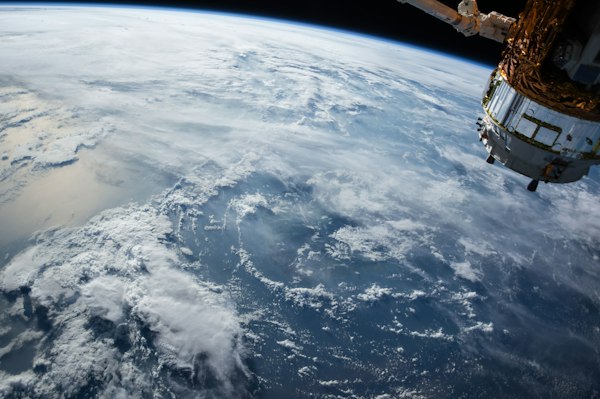
How does GPS know exactly where you are?
Trilateration from 4+ of 31 satellites. Must correct for special + general relativity or positions drift 10 km/day.
Source: NASA, GPS.gov
Explore
Understanding the inventions and systems that power our modern world
The pace of technological innovation is nothing short of awe-inspiring. In barely a century, humanity has gone from the first powered flight to landing rovers on Mars, from room-sized calculators to supercomputers that fit in our pockets. Every device we use, every network we connect to, and every algorithm that shapes our digital lives is the product of brilliant minds building on generations of discovery. Technology is not just about gadgets — it is about the relentless human drive to solve problems, push boundaries, and reimagine what is possible.
"Any sufficiently advanced technology is indistinguishable from magic."
— Arthur C. Clarke
8 Curiosities
Trilateration from 4+ of 31 satellites. Must correct for special + general relativity or positions drift 10 km/day.
Source: NASA, GPS.gov
Surface web: 4-5%. Deep web: 90-95%. Dark web: ~0.01%.
Source: Journal of Electronic Publishing
Maps 68+ landmark points, converts to numerical faceprint. Top systems: 99.97% accuracy.
Source: IEEE
Qubits in superposition (0 AND 1), entanglement enables parallel computation.
Source: IBM Research
John O'Sullivan's radio interference algorithm became IEEE 802.11.
Source: CSIRO Australia
AI recombines patterns without consciousness or intention. Debate continues.
Source: MIT Technology Review
Volta (1800), lead-acid (1859), NiCd (1899), Li-ion (1991). 97% cheaper since 1991.
Source: Royal Society of Chemistry
Distributed append-only ledger with cryptographic hashes. Used for supply chains, voting, identity.
Source: IEEE Spectrum
Keep Exploring